
Imagine you search Google for “How can I improve my website traffic?”
You may see a list of websites, a featured answer, or even an AI-generated response that explains the topic directly.
This is how search is changing. Users want quick, useful, and trustworthy answers, not just a list of links. This is where SEO and AEO become important.
But are SEO and AEO the same? Not exactly. Let’s understand the difference in simple terms.
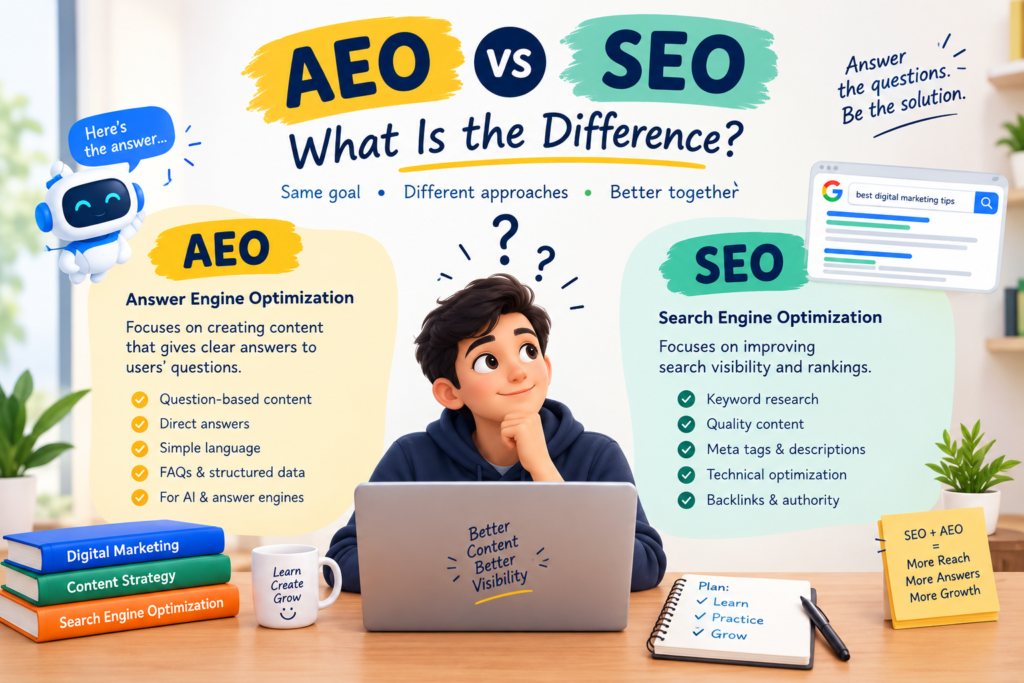
What Does SEO Mean?
SEO means Search Engine Optimization.
SEO is the process of improving a website so that search engines can understand its content and users can discover it through relevant organic searches.
A website’s SEO strategy may include:
- Finding relevant keywords
- Creating useful content
- Improving page titles
- Writing descriptive meta descriptions
- Building internal links
- Improving technical SEO
- Making pages faster and mobile-friendly
- Earning relevant backlinks
- Understanding search intent
Simple Example
Suppose you have a digital marketing website in Lucknow.
You may create a page around:
“Digital Marketing Services in Lucknow.”
SEO helps you optimize that page so it can be discovered by people searching for relevant services.
What Does AEO Mean?
AEO means Answer Engine Optimization.
Instead of focusing only on being found in search results, AEO puts more attention on answering the questions people ask.
Think about the difference:
Traditional search:
“digital marketing services”
Question-based search:
“What does a digital marketing agency do?”
An AEO-friendly article should make the answer easy to find, understand, and use.
AEO content can include:
- Clear question-and-answer sections
- Short answers followed by deeper explanations
- Natural language
- Useful examples
- Well-organized headings
- FAQs
- Reliable information
- Content that matches user intent
AEO vs SEO: The Simple Difference
The easiest way to remember it is:
SEO helps people discover your content. AEO helps your content clearly answer their questions.
| SEO | AEO |
|---|---|
| Focuses on organic search visibility | Focuses on useful answers |
| Uses keywords and topics | Uses questions and user needs |
| Optimizes webpages | Optimizes answer-focused content |
| Covers technical factors | Emphasizes clarity and structure |
| Supports traditional search | Also considers modern answer experiences |
This does not mean you have to choose one over the other. AEO can be used alongside SEO.
Why Should SEO and AEO Work Together?
Think of SEO and AEO as two parts of the same content strategy.
SEO can help a user find your page, while well-structured AEO content can help the user find the answer they need within that page.
For example, imagine you write an article about SEO.
Instead of only discussing the keyword “SEO,” you could answer real questions:
- What is SEO?
- Why does SEO matter?
- How does Google discover a webpage?
- What is technical SEO?
- How long does SEO take?
- What is the difference between on-page and off-page SEO?
This creates content around both the topic and the questions behind the topic.
How Can Beginners Start With AEO?
You do not need a complicated strategy when starting.
Try these practical steps:
- Think like your audience
Write down questions a beginner would ask about your topic. - Study search intent
Understand whether the person wants information, a product, a service, or a solution. - Answer first, explain second
Give a short answer before providing detailed information. - Use natural headings
Turn genuine user questions into useful headings. - Keep your writing simple
Avoid unnecessary technical words. - Add real examples
Examples make difficult digital marketing concepts easier to understand. - Build trustworthy content
Check facts and use reliable sources when making important claims. - Update old articles
Digital marketing changes quickly, so review important content regularly.
AEO Is More Than Adding FAQs
A common mistake is thinking:
“If I add an FAQ section, my content becomes AEO.”
It is not that simple.
FAQs can make content easier to navigate, but AEO is broader. The whole article should provide clear, useful, well-organized answers.
For example, if your heading says:
What Is Technical SEO?
Don’t make the reader search through five paragraphs before finding the answer.
Start with a direct explanation:
Technical SEO focuses on improving the technical aspects of a website so search engines can crawl, understand, and access its content effectively.
Then provide examples and details.
Does AEO Replace SEO?
No.
SEO and AEO address different aspects of modern search.
SEO remains important for website visibility, while AEO encourages marketers to think more deeply about questions, answers, intent, clarity, and usefulness.
A practical strategy can therefore combine both:
SEO + Helpful Content + Search Intent + Clear Answers
Frequently Asked Questions
What is AEO in digital marketing?
AEO stands for Answer Engine Optimization. It focuses on creating content that clearly addresses users’ questions and information needs.
What is the main difference between SEO and AEO?
SEO focuses broadly on improving organic search visibility. AEO focuses more specifically on providing clear answers in answer-oriented search experiences.
Can AEO and SEO be used together?
Yes. A website can use SEO techniques while also creating clear, question-focused content for users.
Is AEO only about AI?
No. AEO is broader than simply optimizing content for AI tools. It focuses on making answers clear and useful in answer-focused search experiences.
How can a beginner learn AEO?
Start with SEO fundamentals, search intent, keyword research, content structure, question-based writing, and helpful content creation.
Final Thoughts
The way people search is evolving. They may search with short keywords, complete questions, or conversational phrases.
That means digital marketers should think beyond “Which keyword should I rank for?”
A better question is:
“What does my audience really want to know, and can my content answer it clearly?”
That is where SEO and AEO can work together.
SEO helps people discover your content. AEO helps you focus on giving them the answer they came for.