
AEO vs GEO is an important topic in modern digital marketing as search continues to evolve beyond traditional blue links. Answer Engine Optimization (AEO) focuses on creating clear, concise, and structured content that helps answer engines provide direct responses to user questions. Generative Engine Optimization (GEO) focuses more broadly on making content useful, understandable, authoritative, and discoverable within AI-powered search and generative experiences. While AEO emphasizes direct answers, featured-answer opportunities, question-based searches, and structured information, GEO considers how generative systems may understand, summarize, and reference information from multiple sources. Both approaches still depend heavily on strong SEO foundations, including crawlable pages, useful original content, clear site structure, and good technical performance. This guide explains the key differences between AEO and GEO, how they work, why they matter, practical optimization techniques, and how businesses can create content that remains valuable across traditional search engines, answer engines, and emerging AI-powered search experiences.
AEO vs GEO: Understanding the Difference
Search is changing rapidly. Users are no longer relying only on traditional search-result pages to find information. They increasingly interact with systems that can provide direct answers, summaries, recommendations, and conversational responses.
This evolution has introduced terms such as AEO (Answer Engine Optimization) and GEO (Generative Engine Optimization).
Although these concepts overlap, they are not exactly the same.
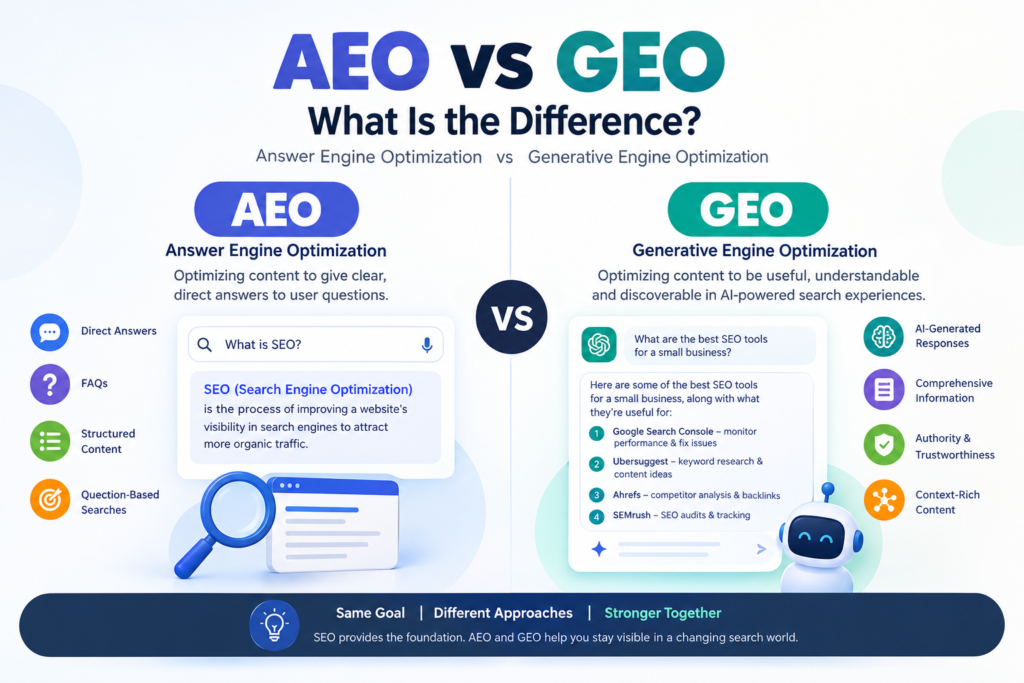
AEO primarily focuses on optimizing content so answer engines can understand and deliver direct answers to user questions. GEO has a broader focus: making content useful and understandable for generative AI-powered search experiences.
Google’s current guidance is particularly important here: SEO fundamentals continue to matter for generative AI features in Search, and Google does not require a special “GEO” markup or a particular schema specifically for generative AI visibility.
What Is AEO?
Answer Engine Optimization (AEO) is the process of structuring and optimizing content so that answer engines can easily identify and provide direct answers to users’ questions.
Traditional SEO often focuses on helping pages appear in search results.
AEO focuses more heavily on the answer itself.
For example, a user might search:
“What is technical SEO?”
An AEO-focused page would provide a clear definition near the beginning:
Technical SEO is the process of improving a website’s technical structure so search engines can crawl, understand, and index its content effectively.
This format makes information easier for systems and users to understand.
Key Characteristics of AEO
AEO commonly emphasizes:
- Direct answers
- Question-based content
- Clear definitions
- FAQ sections
- Conversational queries
- Structured information
- Concise explanations
- Natural-language questions
- Easy-to-scan formatting
The goal is to make information clear, precise, and answerable.
What Is GEO?
Generative Engine Optimization (GEO) refers to optimizing content so it can be effectively understood, processed, and potentially surfaced or referenced by generative AI-powered search experiences.
Unlike a traditional search result that may simply display a webpage title and description, generative systems can synthesize information from multiple sources.
For example, instead of searching:
“Best SEO tools”
a user may ask an AI-powered search system:
“Which SEO tools are useful for a small business, and what should I use each tool for?”
The system may generate a synthesized response based on information it has retrieved or otherwise has access to.
Therefore, GEO emphasizes useful, distinctive, trustworthy, well-structured information rather than simply trying to insert keywords.
Google’s current documentation specifically recommends creating unique, helpful content and maintaining sound technical SEO practices for generative AI search experiences.
AEO vs GEO: Main Differences
| Factor | AEO | GEO |
|---|---|---|
| Full Form | Answer Engine Optimization | Generative Engine Optimization |
| Primary Focus | Direct answers | AI-generated responses and synthesis |
| Content Style | Concise and answer-focused | Comprehensive and context-rich |
| User Intent | Questions and direct information | Complex or conversational information needs |
| Common Content | FAQs, definitions, Q&A | Guides, research, comparisons, expert content |
| Main Goal | Make answers easy to extract | Make information useful for generative systems |
| Structure | Question → Answer | Topic → Context → Evidence → Explanation |
| Relationship with SEO | Works alongside SEO | Strongly dependent on SEO fundamentals |
The distinction should not be treated as a strict technical boundary. In practice, AEO and GEO overlap significantly, and both can benefit from the same strong content and technical foundations.
Why AEO and GEO Matter for Modern SEO
Search engines are becoming increasingly sophisticated in how they understand content and user intent.
Google currently states that its generative AI search experiences are built on its existing Search quality and ranking systems. This means websites should not abandon traditional SEO simply because AI-powered search is growing.
Instead, marketers should build content that works across multiple search experiences.
That means focusing on:
- Search intent
- Helpful information
- Original insights
- Clear organization
- Technical accessibility
- Trustworthy sources
- Strong topical coverage
- Good user experience
Google also advises website owners to ensure pages can be crawled and indexed when they want their content to be eligible for Search experiences.
How to Optimize Content for AEO
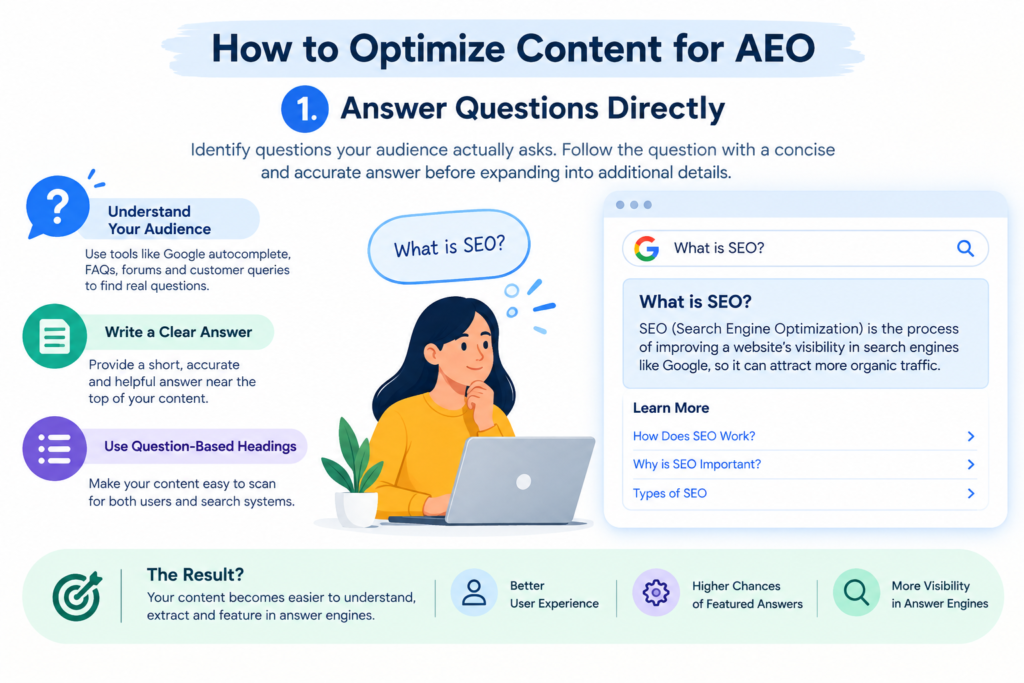
1. Answer Questions Directly
Identify questions your audience actually asks.
For example:
What is SEO?
Follow the question with a concise and accurate answer before expanding into additional details.
This makes your content easier for both readers and information-retrieval systems to understand.
2. Use Question-Based Headings
Use headings such as:
- What is SEO?
- How does SEO work?
- Why is SEO important?
- What is technical SEO?
- How long does SEO take?
This creates a logical relationship between query and answer.
3. Create Helpful FAQ Content
FAQ sections can organize common customer questions in an accessible format.
However, FAQs should contain genuinely useful information rather than being created solely to manipulate search visibility.
4. Use Structured Content
Tables, bullet points, definitions, steps, and short paragraphs can make complicated information easier to understand.
Google notes that structured data can help it understand page content and can support certain Search features, although special schema is not required specifically for generative AI features.
How to Optimize Content for GEO
1. Demonstrate Expertise
Generative search systems need useful information to produce useful responses.
Instead of publishing generic statements, provide:
- Original research
- Practical examples
- Expert explanations
- Case studies
- First-hand experience
- Relevant statistics
- Clear methodology
The objective is to add information value, not simply more words.
2. Build Topical Depth
A single article may not completely establish your expertise on a subject.
Create interconnected content covering different aspects of a topic.
For example, an SEO website could cover:
SEO → Technical SEO → Crawling → Indexing → Canonical Tags → Robots.txt → Core Web Vitals
This creates a broader knowledge structure around the subject.
3. Use Clear and Authoritative Sources
Support factual claims with credible sources where appropriate.
For technical SEO information, official documentation from search engines, recognized industry organizations, academic research, and reliable first-party sources can strengthen the credibility of your content.
4. Create Unique Information
One of the most important GEO principles is originality.
Google’s guidance emphasizes creating unique, helpful content rather than producing large amounts of unoriginal material.
Simply rewriting existing articles with AI does not automatically create authoritative content.
The Role of SEO in AEO and GEO
AEO and GEO should not be viewed as replacements for SEO.
They are better understood as additional ways of thinking about content visibility in an evolving search environment.
Your website still needs:
- Crawlable pages
- Indexable content
- Logical site architecture
- Relevant titles
- Useful content
- Internal linking
- Mobile-friendly design
- Secure HTTPS
- Good page experience
- Appropriate structured data
- Strong technical foundations
Google’s documentation continues to emphasize technical accessibility and helpful, original content for generative AI search experiences.
AEO vs GEO: Simple Example
Imagine you own a digital marketing agency.
A traditional SEO article might target:
“Digital Marketing Agency in Lucknow”
An AEO strategy might target questions such as:
“What does a digital marketing agency do?”
and provide a concise answer.
A GEO-focused strategy could go further by publishing comprehensive information covering:
- Digital marketing services
- SEO
- Google Ads
- Social media marketing
- Local SEO
- Pricing considerations
- Campaign examples
- Industry-specific strategies
- Measurement methods
- Common mistakes
The content becomes a broader and more useful information resource.
Common AEO and GEO Mistakes
Keyword Stuffing
Repeating the same keyword excessively does not make content authoritative.
Write naturally and prioritize the user’s search intent.
Creating Content Only for AI
Content should ultimately serve people.
Google’s guidance emphasizes content created to be helpful and valuable to users rather than content created primarily to manipulate search systems.
Believing in “GEO Hacks”
There is no guaranteed formula that forces a generative AI system to mention a particular website.
Google specifically addresses misconceptions around AEO/GEO tactics and advises focusing on established SEO practices rather than supposed hacks.
Ignoring Technical SEO
Excellent content cannot compensate for serious crawling or indexing problems.
Your website needs to be technically accessible to search systems.
A Practical AEO + GEO Strategy
A modern content strategy can combine both approaches.
Step 1: Research Search Intent
Understand what users are trying to accomplish.
Step 2: Identify Questions
Collect informational, commercial, navigational, and conversational questions.
Step 3: Create a Direct Answer
Give users a clear answer near the beginning of the page.
Step 4: Add Comprehensive Context
Explain the topic with examples, evidence, comparisons, and practical advice.
Step 5: Demonstrate Expertise
Add original insights, experience, data, and credible references.
Step 6: Improve Technical SEO
Make sure the page can be crawled, rendered, indexed, and understood.
Step 7: Monitor Performance
Use tools such as Google Search Console to monitor how your website performs across Search experiences. Google has also introduced reporting for generative AI features and, as of September 2026, additional reporting for multimodal search.
The Future of Search: SEO + AEO + GEO
The future of search is not necessarily about choosing between SEO, AEO, and GEO.
Instead, these concepts can be considered different perspectives on the same fundamental objective:
Create valuable information that people can understand and search systems can discover, interpret, and present appropriately.
AEO emphasizes answers.
GEO emphasizes generative experiences and broader information synthesis.
SEO provides the technical and content foundation that supports discoverability.
For businesses, the practical approach is therefore to create content that is:
Helpful + Original + Authoritative + Structured + Technically Accessible + User-Focused.
That approach aligns closely with Google’s current guidance for both traditional and generative search experiences
Conclusion
AEO and GEO represent important developments in the evolution of search.
AEO focuses primarily on providing clear answers to specific questions, while GEO focuses more broadly on making information useful and understandable within generative AI-powered search experiences.
The two approaches overlap, and neither should be treated as a replacement for SEO.
For long-term visibility, businesses should focus on creating original, useful, trustworthy, well-structured content, supported by solid technical SEO. This gives content a stronger foundation across traditional search, answer-focused experiences, and generative AI search.
The most sustainable strategy is not to chase an algorithmic “hack.” It is to be genuinely useful, demonstrate expertise, answer real questions, and provide information that offers value beyond what is already available. Google itself recommends this user-first approach for generative AI search.
Suggested SEO Title
AEO vs GEO: What Is the Difference? Complete Guide
Suggested H1
AEO vs GEO: What Is the Difference?
Suggested Focus Keywords
- AEO vs GEO
- Answer Engine Optimization
- Generative Engine Optimization
- GEO vs AEO
- AEO SEO
- Generative Engine Optimization SEO
- AI search optimization
- AI SEO
- AEO and GEO
Authority-source note
For your blog, Google Search Central is an especially useful primary source because its current documentation directly addresses generative AI search optimization, SEO fundamentals, structured data, crawling/indexing, and misconceptions around AEO/GEO.