
Introduction
Marketing is the backbone of every successful business. No matter how great a product or service is, customers need to know it exists before they can make a purchase. Over the years, marketing has evolved significantly, moving from traditional methods such as newspapers, television, and radio to digital platforms like search engines, social media, websites, and email.
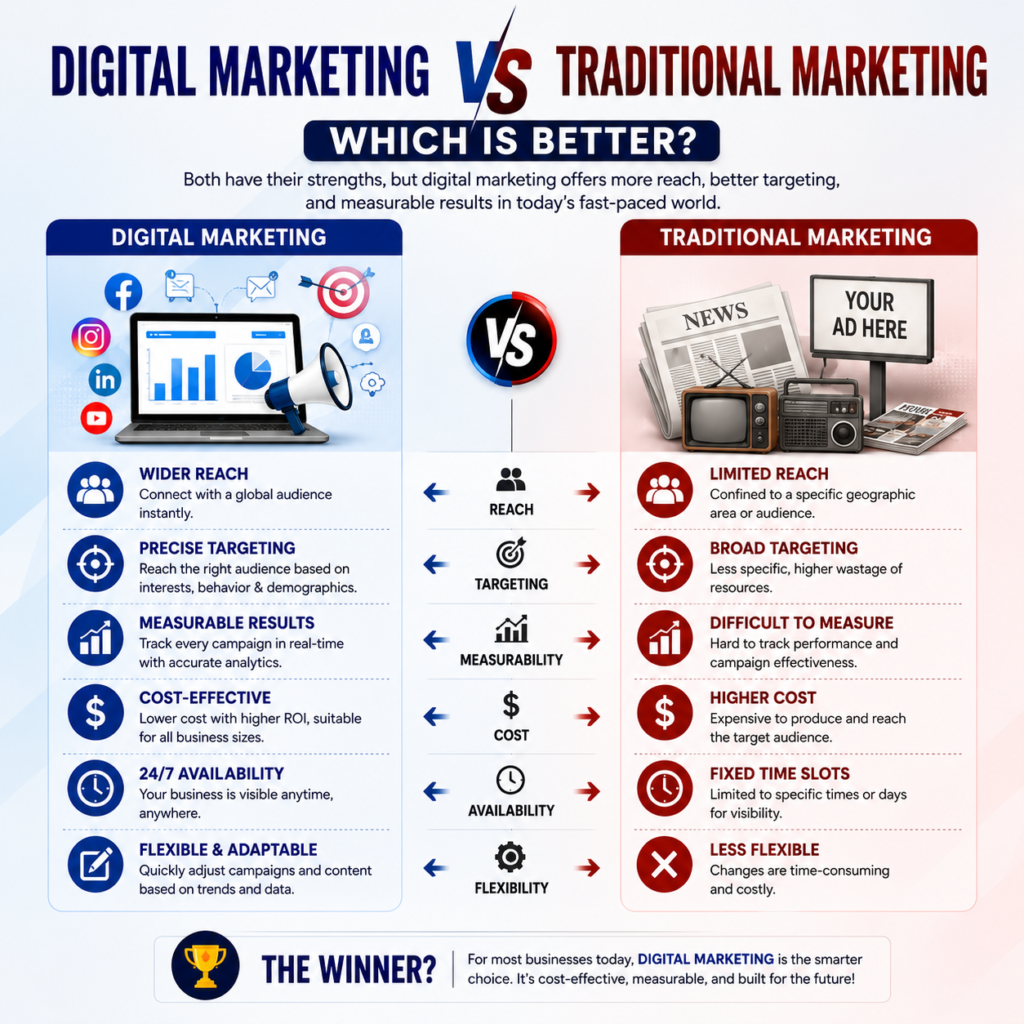
Today, businesses face an important question: Should they invest in traditional marketing or digital marketing? While both approaches aim to promote products and attract customers, they differ in terms of cost, reach, targeting, engagement, and measurable results.
Understanding the strengths and limitations of each marketing method can help businesses make informed decisions and choose the right strategy for their goals. In this article, we’ll compare digital marketing and traditional marketing to determine which is better for modern businesses.
What Is Traditional Marketing?
Traditional marketing refers to conventional advertising methods that existed before the rise of the internet. These marketing channels are used to reach audiences through offline media.
Common examples of traditional marketing include:
- Newspaper advertisements
- Magazine advertisements
- Television commercials
- Radio advertisements
- Billboards
- Flyers and brochures
- Direct mail campaigns
- Event sponsorships
Traditional marketing has been used successfully for decades and remains effective for certain industries and audiences.
What Is Digital Marketing?
Digital marketing involves promoting products and services through online channels and digital technologies. It allows businesses to connect with customers through the internet and mobile devices.
Common digital marketing channels include:
- Search Engine Optimization (SEO)
- Social Media Marketing
- Google Ads
- Email Marketing
- Content Marketing
- Video Marketing
- Influencer Marketing
- Website Marketing
Digital marketing focuses on reaching consumers where they spend much of their time—online.
Key Differences Between Digital Marketing and Traditional Marketing
1. Reach and Audience
Traditional Marketing
Traditional marketing generally targets a broad audience. For example, a television commercial may reach thousands or millions of viewers, but many of them may not be interested in the advertised product.
While traditional marketing can provide strong local and regional exposure, its reach is often limited by geographic location.
Digital Marketing
Digital marketing offers global reach. Businesses can connect with customers across cities, countries, and even continents.
Online platforms allow businesses to target specific audiences based on:
- Age
- Gender
- Interests
- Location
- Online behavior
- Purchase history
Winner: Digital Marketing
Its ability to reach a highly targeted audience worldwide gives it a significant advantage.
2. Cost Effectiveness
Traditional Marketing
Traditional advertising often requires substantial budgets. Television commercials, newspaper ads, and billboards can be expensive, especially for small businesses.
In many cases, businesses must invest large amounts without knowing exactly how effective the campaign will be.
Digital Marketing
Digital marketing offers affordable options suitable for businesses of all sizes.
Examples include:
- SEO
- Social media marketing
- Content marketing
- Email marketing
Businesses can start with small budgets and scale campaigns based on results.
Winner: Digital Marketing
It provides better value for money and is accessible to businesses with limited resources.
3. Targeting Capabilities
Traditional Marketing
Traditional marketing provides limited audience targeting. Advertisements are shown to large groups of people regardless of whether they are interested in the product.
For example, a newspaper ad reaches everyone reading the newspaper, not just potential customers.
Digital Marketing
Digital marketing allows highly precise targeting.
Businesses can target users based on:
- Demographics
- Interests
- Location
- Online behavior
- Device usage
This ensures marketing messages reach the people most likely to convert.
Winner: Digital Marketing
Advanced targeting significantly improves marketing efficiency.
4. Measurability and Analytics
Traditional Marketing
Measuring the success of traditional campaigns can be difficult.
Businesses may estimate effectiveness through:
- Sales increases
- Customer surveys
- Coupon redemptions
However, detailed data is often unavailable.
Digital Marketing
Digital marketing provides real-time analytics and performance tracking.
Businesses can measure:
- Website traffic
- Clicks
- Conversions
- Engagement rates
- Customer behavior
- Return on investment (ROI)
These insights help marketers improve campaigns continuously.
Winner: Digital Marketing
The ability to measure results accurately makes decision-making much easier.
5. Customer Engagement
Traditional Marketing
Traditional marketing is typically one-way communication. Businesses deliver messages to audiences without direct interaction.
Customers have limited opportunities to respond immediately.
Digital Marketing
Digital marketing encourages two-way communication.
Customers can:
- Comment on social media posts
- Send direct messages
- Participate in polls
- Leave reviews
- Interact with brands instantly
This interaction helps build stronger relationships and customer loyalty.
Winner: Digital Marketing
Engagement opportunities are far greater online.
6. Speed and Flexibility
Traditional Marketing
Creating traditional marketing campaigns often requires significant planning and production time.
Updating or changing a printed advertisement after publication can be costly and time-consuming.
Digital Marketing
Digital campaigns can be launched, adjusted, or paused within minutes.
Businesses can quickly:
- Change ad copy
- Update targeting
- Test new strategies
- Optimize campaigns
Winner: Digital Marketing
Its flexibility allows businesses to adapt quickly to market changes.
7. Brand Trust and Credibility
Traditional Marketing
Traditional media channels often carry a sense of authority and credibility. Television, newspapers, and magazines are generally viewed as trustworthy sources.
For some audiences, appearing in traditional media can enhance a brand’s reputation.
Digital Marketing
Digital marketing builds trust through:
- Customer reviews
- Testimonials
- Educational content
- Social proof
- Consistent online presence
Both methods can effectively build credibility when used correctly.
Winner: Tie
Each approach offers unique trust-building advantages.
8. Long-Term Results
Traditional Marketing
Traditional advertising often delivers short-term visibility. Once a campaign ends, exposure typically disappears.
Digital Marketing
Many digital marketing strategies continue generating results long after implementation.
Examples include:
- SEO rankings
- Blog content
- Email subscriber lists
- Social media communities
These assets continue delivering value over time.
Winner: Digital Marketing
Its long-term impact provides greater sustainability.
When Traditional Marketing Works Best
Traditional marketing may still be effective when:
- Targeting older demographics
- Promoting local events
- Building broad brand awareness
- Reaching audiences with limited internet access
- Advertising in niche print publications
Certain industries and markets continue to benefit from traditional advertising methods.
When Digital Marketing Works Best
Digital marketing is ideal when businesses want to:
- Generate leads online
- Increase website traffic
- Reach specific audiences
- Measure campaign performance
- Improve customer engagement
- Scale marketing efforts efficiently
- Maximize return on investment
For most modern businesses, digital marketing offers unmatched flexibility and effectiveness.
Can Businesses Use Both?
Absolutely.
The most successful companies often combine traditional and digital marketing into an integrated marketing strategy.
For example:
- A television advertisement can direct viewers to a website.
- A billboard can promote social media accounts.
- Print materials can include QR codes linking to online content.
Combining both approaches can create a stronger and more consistent brand presence.
Conclusion
When comparing digital marketing and traditional marketing, both have their strengths. Traditional marketing remains useful for certain audiences and situations, particularly when building local awareness or targeting demographics that consume offline media.
However, digital marketing offers clear advantages in today’s business environment. Its affordability, precise targeting, measurable results, global reach, and customer engagement capabilities make it the preferred choice for most businesses.
For companies seeking growth, lead generation, brand awareness, and long-term success, digital marketing provides the tools and opportunities needed to thrive in a competitive marketplace. While traditional marketing still has a place, digital marketing has become the driving force behind modern business success.
Final Verdict: Digital Marketing is generally the better option for most businesses because it delivers higher ROI, better targeting, measurable results, and greater scalability in today’s digital-first world.