
Introduction
Digital marketing has become the backbone of modern business growth. As consumers spend more time online, businesses must adopt effective digital marketing strategies to reach their audience, generate leads, and increase sales. Whether you own a small business, an e-commerce store, or a large company, digital marketing provides powerful opportunities to connect with potential customers and build long-term relationships.
In 2026, digital marketing is more competitive than ever. New technologies, changing consumer behavior, and evolving online platforms require businesses to stay updated and adapt their marketing approaches. Companies that implement the right digital marketing strategies can improve brand awareness, drive website traffic, and achieve sustainable growth.
This blog explores the top digital marketing strategies that can help businesses succeed in 2026 and beyond.
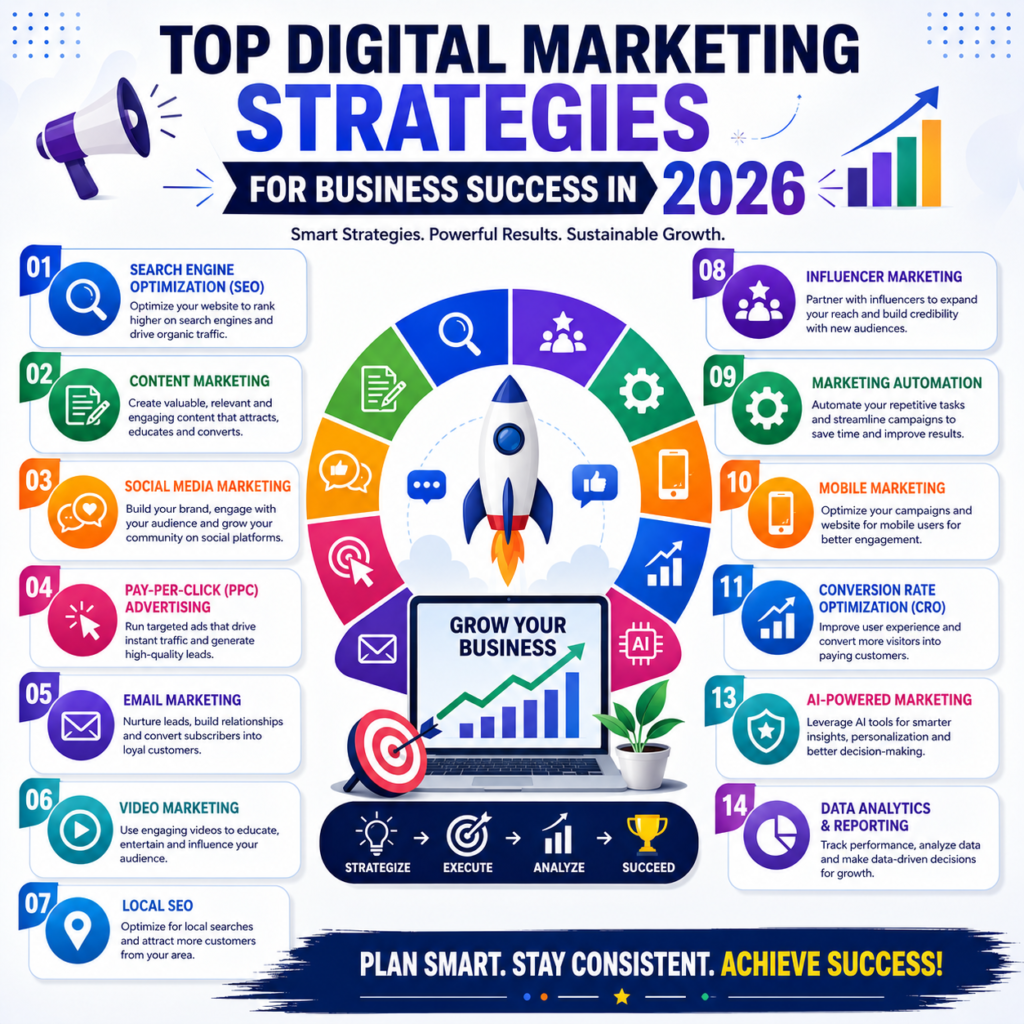
1. Search Engine Optimization (SEO)
SEO remains one of the most effective digital marketing strategies.
SEO is the process of optimizing your website to rank higher on search engines like Google. When potential customers search for products or services related to your business, SEO helps your website appear in search results.
Benefits of SEO
- Increases organic traffic
- Improves online visibility
- Builds credibility and trust
- Generates long-term results
- Reduces dependence on paid advertising
Key SEO practices include keyword research, content optimization, technical SEO, link building, and improving website speed.
Businesses that invest in SEO can attract qualified traffic and generate consistent leads over time.
2. Content Marketing
Content marketing focuses on creating valuable and informative content that attracts and engages potential customers.
Popular content formats include:
- Blog posts
- Articles
- Videos
- Infographics
- E-books
- Case studies
- Guides
High-quality content helps businesses establish authority in their industry while improving search engine rankings.
Why Content Marketing Works
Consumers often research online before making purchasing decisions. By providing useful information, businesses can build trust and position themselves as experts.
Content marketing also supports SEO, social media marketing, and email campaigns.
3. Social Media Marketing
Social media platforms continue to play a major role in digital marketing success.
Popular platforms include:
- YouTube
- TikTok
Businesses use social media to:
- Build brand awareness
- Engage with audiences
- Share content
- Promote products and services
- Generate leads
Regular posting and meaningful interaction with followers can help businesses grow their online presence and strengthen customer relationships.
4. Pay-Per-Click (PPC) Advertising
PPC advertising allows businesses to place ads on search engines and social media platforms.
Advertisers only pay when users click on their ads.
Popular PPC platforms include:
- Google Ads
- Meta Ads
- LinkedIn Ads
- YouTube Ads
Benefits of PPC
- Immediate visibility
- Fast lead generation
- Precise audience targeting
- Measurable results
- Flexible budgets
PPC campaigns can produce quick results while supporting long-term marketing goals.
5. Email Marketing
Email marketing remains one of the highest ROI digital marketing strategies.
It allows businesses to communicate directly with customers and nurture relationships over time.
Common email campaigns include:
- Newsletters
- Promotional offers
- Product updates
- Educational content
- Customer follow-ups
Benefits of Email Marketing
- High engagement rates
- Personalized communication
- Increased customer retention
- Improved sales opportunities
Building and maintaining an email list is a valuable asset for any business.
6. Video Marketing
Video content is one of the most engaging forms of digital marketing.
Consumers increasingly prefer watching videos over reading lengthy text.
Popular video content includes:
- Tutorials
- Product demonstrations
- Customer testimonials
- Educational videos
- Brand stories
Platforms such as YouTube, Instagram Reels, Facebook Reels, and TikTok offer excellent opportunities for businesses to reach large audiences.
Why Video Marketing Matters
Videos can communicate information quickly while increasing engagement and conversion rates.
7. Local SEO
For businesses serving specific locations, Local SEO is essential.
Local SEO helps businesses appear in searches such as:
- “Digital marketing agency near me”
- “Best restaurant in Lucknow”
- “Website designer nearby”
Important Local SEO strategies include:
- Optimizing Google Business Profile
- Collecting customer reviews
- Using location-specific keywords
- Creating local content
Local SEO increases visibility among nearby customers who are actively searching for services.
8. Influencer Marketing
Influencer marketing continues to grow in popularity.
Businesses partner with influencers who have loyal audiences and strong credibility.
Influencers can help:
- Promote products
- Increase brand awareness
- Build trust
- Drive sales
Micro-influencers often provide excellent results because their followers tend to be highly engaged.
Authentic recommendations from trusted influencers can significantly impact purchasing decisions.
9. Marketing Automation
Marketing automation helps businesses streamline repetitive tasks.
Automation tools can handle:
- Email campaigns
- Lead nurturing
- Social media scheduling
- Customer follow-ups
- Analytics reporting
Benefits of Automation
- Saves time
- Improves efficiency
- Enhances personalization
- Increases productivity
Businesses can focus on strategy while automation handles routine processes.
10. Mobile Marketing
Mobile devices now account for the majority of internet usage.
Businesses must ensure that their marketing efforts are optimized for mobile users.
Mobile marketing includes:
- Responsive websites
- Mobile advertisements
- SMS marketing
- Mobile-friendly emails
A positive mobile experience improves engagement and conversion rates.
11. Conversion Rate Optimization (CRO)
Generating traffic is important, but converting visitors into customers is even more valuable.
Conversion Rate Optimization focuses on improving website performance through:
- Better landing pages
- Clear calls-to-action
- Faster loading times
- Improved user experience
- A/B testing
Even small improvements in conversion rates can significantly increase revenue.
12. Artificial Intelligence (AI) Marketing
AI is transforming digital marketing in 2026.
Businesses use AI for:
- Customer insights
- Content creation
- Chatbots
- Predictive analytics
- Personalized recommendations
AI helps marketers make data-driven decisions and deliver better customer experiences.
As technology advances, AI will become an increasingly important part of digital marketing strategies.
13. Online Reputation Management
A business’s online reputation can directly impact sales and customer trust.
Businesses should actively manage:
- Customer reviews
- Social media comments
- Online mentions
- Brand feedback
Responding professionally to customer concerns demonstrates commitment to customer satisfaction.
Positive online reputations encourage new customers to trust and choose your business.
14. Data Analytics and Reporting
Data is one of the most valuable assets in digital marketing.
Analytics tools help businesses measure:
- Website traffic
- Conversion rates
- Campaign performance
- Customer behavior
- Return on investment (ROI)
By analyzing performance data, businesses can improve strategies and maximize results.
Successful marketing decisions are based on insights rather than assumptions.
The Future of Digital Marketing
The future of digital marketing will be shaped by:
- Artificial Intelligence
- Voice Search
- Personalized Experiences
- Video Content
- Automation
- Interactive Marketing
Businesses that stay informed and adapt to new technologies will have a competitive advantage.
The key to success is focusing on customer needs while leveraging the latest digital tools and strategies.
Conclusion
Digital marketing continues to be one of the most effective ways to grow a business in 2026. Strategies such as SEO, content marketing, social media marketing, email marketing, PPC advertising, video marketing, and AI-powered automation help businesses attract customers and increase revenue.
The most successful companies do not rely on a single marketing channel. Instead, they combine multiple strategies to create a comprehensive digital marketing plan that supports their goals.
By implementing these top digital marketing strategies and staying updated with industry trends, businesses can improve visibility, build stronger customer relationships, and achieve long-term success in an increasingly digital world.